

Housing prices across fast-growing metros have pushed buyers to look for smarter ways to own without stretching every paycheck. Enter house hacking — a proven strategy that turns your largest monthly expense into a wealth-building asset.
The idea is simple: buy a residential multi-unit property — a duplex, triplex, or fourplex — live in one unit as your primary residence, and rent out the rest. Your tenants' rent offsets, covers, or even exceeds your monthly mortgage payment.
House hacking is an owner-occupied strategy where a buyer purchases a 1-to-4 unit residential property, lives in one unit, and rents the remaining units to generate income that subsidizes the property's mortgage, insurance, taxes, and maintenance.
And few markets set the stage better than Charlotte, North Carolina — a roaring corporate economy, steady in-migration, and deep rental demand. As a design-build infill builder, JCB Urban has spent 25+ years building exactly the kind of duplexes and townhomes in Charlotte's established neighborhoods that make this strategy work. Here's the complete playbook.
What Is House Hacking?

The Core Concept
Instead of buying a single-family home where you carry 100% of the mortgage, taxes, and insurance out of pocket, you buy a multi-unit property. Because you occupy one unit as your primary residence, you qualify for favorable residential financing — lower down payments and lower rates than any investment loan.
Why It Works
- Low barrier to entry: Investment loans typically require 20–25% down. Owner-occupied loans allow as little as 0–5%.
- Subsidized living: Rental income pays down your principal while offsetting operating costs every month.
- Wealth acceleration: Money you no longer spend on housing goes to savings, investments, or your next property.
Common Misconceptions
- "I'll have to share my kitchen." Classic house hacking uses duplexes, triplexes, and fourplexes where every unit has its own private entrance, kitchen, bath, and living space.
- "Being a landlord takes over your life." Managing one to three neighboring units takes a few hours a month with online rent collection, screening tools, and clear leases.
- "It's probably not allowed." Renting units in a legally zoned 2–4 unit property is fully legal in Charlotte, provided you follow occupancy codes and lease regulations.
Property Types
Residential mortgage guidelines cover properties with 1 to 4 units; five or more units becomes commercial lending. That means a duplex (2 units), triplex (3 units), or fourplex (4 units) all qualify for standard home loans.
Why Charlotte Is a Great House Hacking Market
- Economic engine: Charlotte is the second-largest U.S. banking center, home to Bank of America and major operations for Truist and Wells Fargo — plus Atrium Health, Novant Health, Lowe's Tech Hub, Honeywell, and Duke Energy.
- Population growth: Thousands of new residents arrive in the metro every month, sustaining a deep pool of quality renters.
- Transit corridors: The LYNX Blue Line and CATS investments keep rental demand strong from South End through NoDa and University City.
- Forward-thinking zoning: Charlotte's Unified Development Ordinance (UDO) encourages moderate density, making duplexes and ADUs viable across more neighborhoods than ever.
The Math: How House Hacking Cuts Your Housing Cost

Your net monthly housing cost equals your total mortgage payment (principal, interest, taxes, insurance — PITI) plus operating expenses, minus gross rental income. A complete analysis always includes property taxes, landlord insurance, maintenance reserves (5–10% of rent), capital expenditure reserves for big-ticket items, a 5% vacancy budget, and utility metering.
See the math on a real home: 7014 Ware Rd is a new-construction duplex in Charlotte's Idlewild neighborhood — two ~1,505 sq ft units with private entrances, 6 bedrooms total, offered at $680,000 and designed specifically for house hacking. Live in one side, and let the other side's rent work on your mortgage. View the listing →
Financing a House Hack in Charlotte

- FHA loans — 3.5% down. Available on 1–4 unit owner-occupied properties with flexible credit guidelines. Note: 3- and 4-unit properties must pass FHA's self-sufficiency test (75% of projected rents must cover the full payment); duplexes are exempt. Details at hud.gov.
- VA loans — 0% down. Eligible veterans and active-duty buyers can purchase up to 4 units with no down payment and no monthly PMI, occupying one unit. See va.gov.
- Conventional — 5% down. Fannie Mae allows 5% down on owner-occupied 2–4 unit properties, and PMI can be cancelled at 20% equity (see fanniemae.com).
Occupancy Rules
To get owner-occupied terms, lenders require you to move in within 60 days of closing and live there as your primary residence for at least 12 months. After that, you're generally free to move out, rent your unit, and repeat the strategy with your next property.
Using Projected Rent to Qualify
Lenders typically count 75% of projected gross rent from the units you won't occupy toward your qualifying income, documented through the appraisal's rent schedule or executed leases. That haircut accounts for vacancy and maintenance.
Duplex vs. Triplex vs. Fourplex
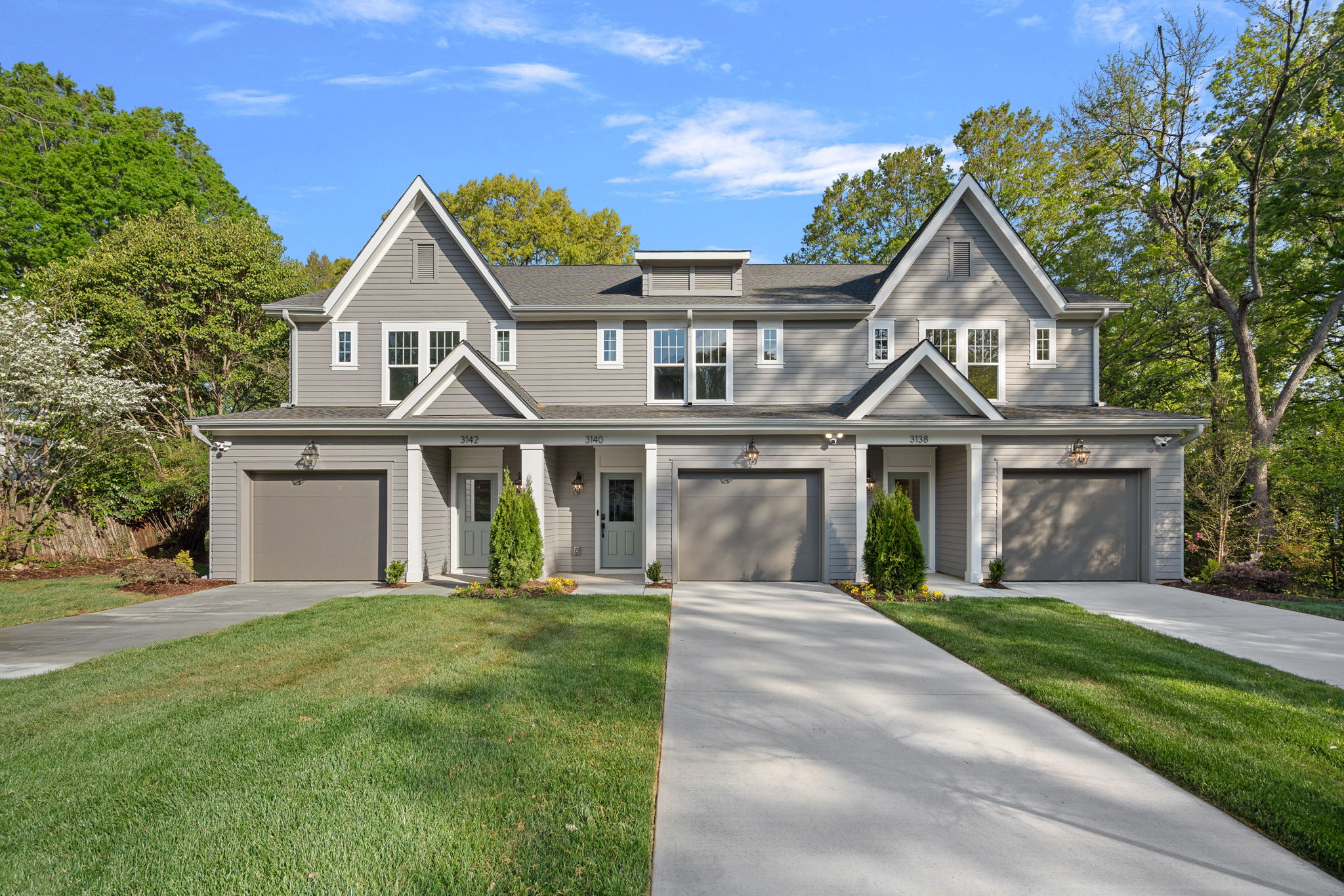
- Duplex (2 units): Most common in Charlotte, simplest financing (FHA/VA/conventional with no self-sufficiency test), maximum privacy, typically offsets 40–80% of the mortgage. One vacancy means losing half your rental income.
- Triplex (3 units): Less common, moderate management, typically offsets 80–110% of the mortgage. Subject to FHA's self-sufficiency test.
- Fourplex (4 units): Rare and competitive, highest income potential — can fully cover the payment and cash flow — with the most management and the smallest vacancy impact per unit.
Choose a duplex if you value privacy, straightforward financing, and easy management. Choose a triplex or fourplex if eliminating your housing payment entirely is the goal.
Best Charlotte Neighborhoods for House Hacking

- Urban core adjacent — NoDa, Plaza Midwood, FreeMoreWest: Walkable, creative hubs with historic duplexes and new infill builds. Young professionals and creatives pay a premium to live here, and long-term appreciation prospects are strong.
- Transit corridors — South End, LoSo, Montclaire: Modern townhome-style duplexes along the LYNX Blue Line. Light-rail access keeps vacancy low.
- University & North Charlotte — University City, Highland Creek edge: Lower entry prices with continuous demand from UNC Charlotte students, faculty, and Atrium Health staff.
- Suburban growth nodes — Matthews, Pineville, Steele Creek: Stable, family-oriented settings with lower turnover and long-term tenant stability.
How to Find a Duplex, Triplex, or Fourplex
- MLS alerts: Search beyond "duplex" — include "accessory dwelling unit," "in-law suite with private entry," "duplex zoning," and "basement apartment with exterior entrance."
- Off-market sourcing: Direct outreach to long-term owners, wholesaler networks, and driving target neighborhoods for properties with deferred maintenance.
- Buy new, direct from the builder: Charlotte's small multi-family inventory is scarce and competitive. New-construction duplexes and townhomes — like the ones JCB Urban builds in neighborhoods such as Plaza Midwood, Villa Heights, and Ashley Park — skip the bidding wars on aging stock entirely. Browse our available homes to see what's move-in ready now, including our newest offering: a house-hackable duplex at 7014 Ware Rd, designed for exactly this strategy.
Why New Construction Is a House Hacker's Edge

Most house hacking math gets wrecked by one thing: surprise repairs on older buildings. A 60-year-old duplex with an original roof, aging HVAC, and a shared electric meter can burn through years of reserves fast. New construction changes the equation:
- Minimal early CapEx: Roof, HVAC, water heater, and appliances all start at year zero — your capital-expenditure reserves actually accumulate instead of draining.
- Warranty coverage: Builder warranties cover the exact repair categories that blindside first-time landlords.
- Separate utilities by design: Modern duplexes are built with separately metered units — no bill-splitting clauses, no meter retrofits.
- Tenant appeal: Quartz counters, stainless appliances, and in-unit laundry rent faster and at stronger rates than dated units.
- Code-compliant from day one: Legally permitted multi-family under Charlotte's UDO — no zoning surprises during lending or insurance.
Already own a lot? Under the UDO, many Charlotte lots now support a duplex or an ADU. Our Build on Your Lot program handles design, permitting, and construction under one roof — a path to a house hack built to your spec. Learn how it works on our process page.
Common First-Time Mistakes
- Underestimating maintenance on older buildings — always inspect thoroughly and reserve roughly 15% of rents.
- Skipping tenant screening — you're living next door; run credit, background, employment, and prior-landlord checks every time.
- Blurring boundaries — be friendly, but run maintenance requests and rent through a portal, not the driveway.
- Ignoring utility metering — shared meters mean you pay the bill or write careful splitting terms into the lease.
- Assuming zoning — verify the property is legally permitted as multi-family under Charlotte's UDO (see charlottenc.gov) before you buy.
Frequently Asked Questions
Can I buy a duplex in Charlotte with an FHA loan?
Yes — FHA allows 1–4 unit properties with 3.5% down, provided you occupy one unit as your primary residence for at least 12 months.
How much down payment do I need?
VA: 0% for eligible veterans. FHA: 3.5%. Conventional: 5% on owner-occupied 2–4 unit properties.
Can rental income help me qualify for the loan?
Usually yes — lenders typically count up to 75% of projected rent from the tenant units toward your debt-to-income ratio. Requirements vary by lender.
How long do I have to live there?
Move in within 60 days of closing and stay at least 12 months. After that, you can rent your unit and buy your next primary residence.
Is house hacking legal in Charlotte?
Yes — in any legally zoned duplex, triplex, fourplex, or home with a permitted ADU, as long as you follow local zoning, safety codes, and occupancy standards.
Duplex or triplex for a first-timer?
A duplex is easier to find, simpler to finance, and more private. A triplex or fourplex generates more income and can eliminate your housing payment entirely.
Can I house hack more than once?
Yes — many buyers repeat the cycle every 12+ months, converting each former unit into a rental and building a portfolio.
Final Thoughts & Next Steps
House hacking combines owner-occupied financing with income-producing real estate — reducing your housing cost, accelerating savings, and building long-term equity. Success comes down to the right property, the right loan, honest expense math, and professional management.
JCB Urban builds design-forward duplexes and townhomes in the Charlotte neighborhoods where this strategy works best. Whether you want a move-in-ready home with income potential or a duplex built on your own lot, we can help you weigh the options, understand what new construction changes about the math, and connect you with lenders who know owner-occupied multi-family programs.
Contact JCB Urban to talk through your Charlotte house hack, browse our available homes, or go straight to the 7014 Ware Rd duplex listing.
JCB Urban Company is a Charlotte, North Carolina design-build infill homebuilder. For 25+ years, we've crafted modern single-family homes, duplexes, and townhomes in the city's established neighborhoods, alongside 300+ affordable homes delivered with community partners.